
Swimming Lessons
The dread of a holiday swim, and what it has to teach about control.

I knew I wasn’t going to swim. As I packed my suitcase on a Friday morning I paused briefly in front of the drawer in which, beneath out of season fleeces and an unused cycling helmet, was my swimming costume. The others, I knew, wanted to swim. They always wanted to swim, and I had said I’d bring my costume but would make no promises. I lingered for a breath in front of the drawer, but it stayed closed. I wasn’t going to swim.
I have always felt the cold. On sports day when I was six I clung shivering to the edge of the outdoor pool, refusing to move anything but my chattering teeth; the other children splashed their two widths and although the teacher coaxed me and my mum looked angry I could not swim, frozen as I was, almost literally, to the side. In winter my blood protests the temperature by refusing to enter my hands, turning three fingers the grotesque yellow-white of a corpse found in the woods. I don’t like to be cold. I like to turn my skin shocking pink in long baths, I like to walk around in the sun. I don’t like to swim in the sea.
My friends love to swim. I think I have by now spent hours perched on rocks at the edges of lakes, next to rivers and on the shores of seas watching and waiting as they plunge into black or blue ice water. I have watched their small heads move placidly like round ducks across glassy surfaces. I have taken the photos and looked after the bags and happily facilitated their hobby. I have joined once or twice, exclusively on days that broke the national temperature record, but mostly I have waved and smiled and said there is absolutely no way I’m getting in. I knew I didn’t want to.
On our first morning I said that I had accidentally-on-purpose forgotten my swimming stuff and they laughed because that is so me and offered to pack me a spare, which I accepted because it was easier to let them think there was a chance. I knew I wasn’t going to swim. We went on our coastal hike, a day that was warmer than any we’d had for months. My back and hips ached and my stomach churned, a combination of sensitive car sickness and too many cocktails on too little food the night before. I began to feel like I fancied some cold, some refreshment as a hard reset, but I kept that to myself. I knew I probably wouldn’t swim.
It was low tide when we picked our way down the cliff steps, over the razor-edged rocks and down the pebbles to the shore. I paddled my bare feet in the cold as the other two huddled in a shaded corner to change, giggling with anticipation and I just… decided. “Ok I’m going in” I said, as they squealed and pulled out the spare costume. We held hands as we inched through the shallows, squealing and cackling as seaweed was stepped on, stubbing our toes on the rocks and then, eventually, sinking into the water.
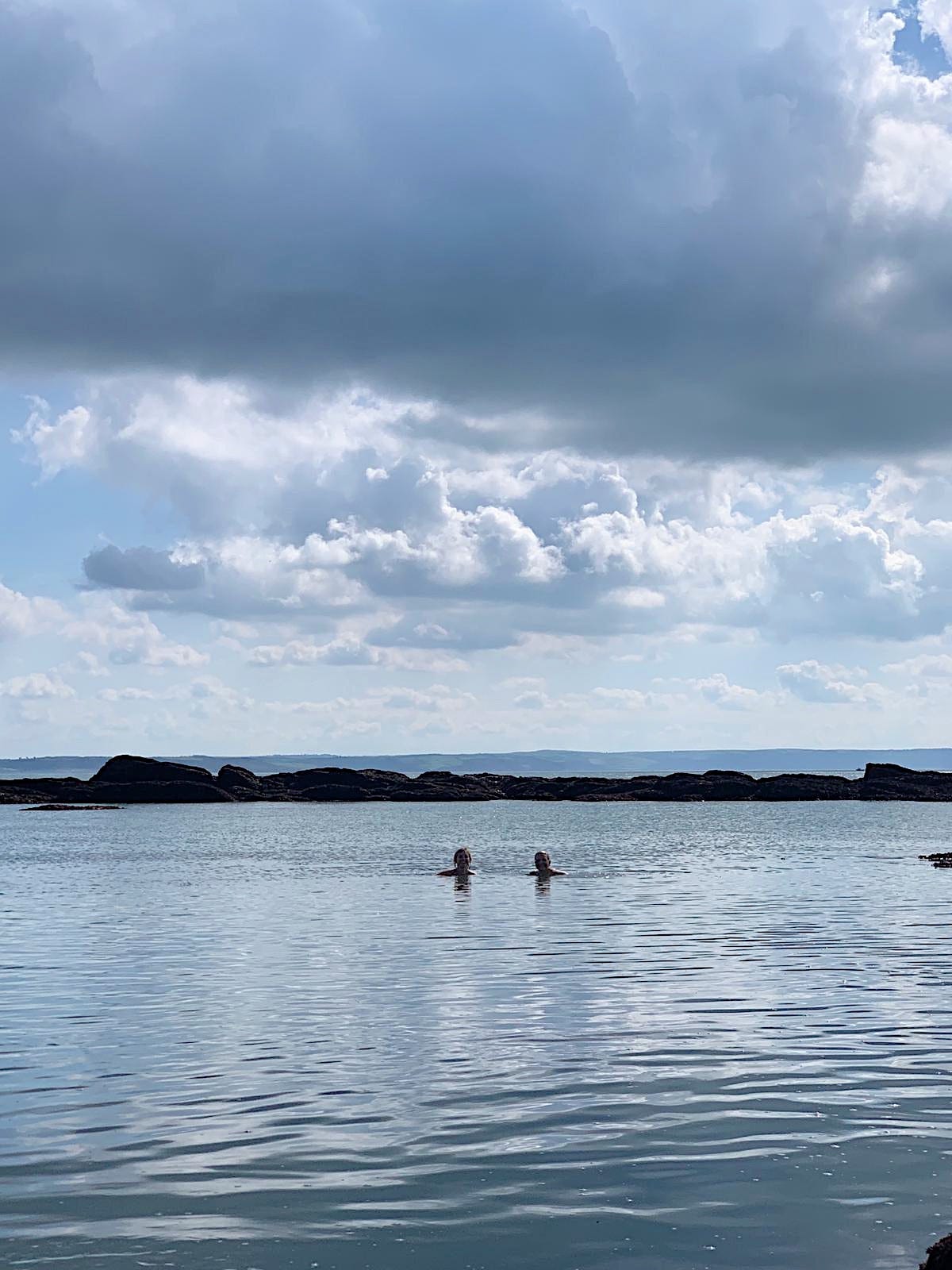
The first few minutes are unavoidably horrid. The shock of the cold on your spine, pushing the air out of your lungs, the frantic kicking for the need of something to do about the temperature. Oh but after that. Sea swimming is exactly like a romanticised film montage of sea swimming. The flecks of silver on the surface, the lens flare in your eyes, white limbs under turquoise water, the gentle ebb of your eye line. We lay on our backs and joined our feet, we played tricks on each other about fish, we laughed until the brine got in our mouths and then we laughed more.
Afterwards we sat in a line on a flat rock quietly watching the horizon, draped in a rainbow of striped towels letting the sun dry the salt onto our skin. When we were in the water I’d said “I hate to say this because I know it will be held against me in the future, but I’m so glad I got in”. I was cured of my sickness, cured of my muscle stiffness, cured of my worry about swimming. What is actually the problem then? I asked myself. What is it you really don’t like?
I don’t like the cold, that is still true, but I also know that the cold lasts only a few minutes, and that those few minutes are almost as funny as they are uncomfortable. And after that there’s the fun, and after that there’s the pride. As much as I knew before that the cold was the reason I didn’t want to swim, I know now that it’s not. It’s the excuse I have for not wanting to swim.
I wondered if it was the admin, the squeezing into a swimsuit and doing the knicker-trick and hiding your bra in your shorts and clamping a towel under your armpit for absolute dear life, and then, worse, doing the whole thing in reverse only more cold and more wet and more naked. But there we were drying out on a rock, and then we’d wear our towels as skirts and walk along the coast path to the cafe with changing rooms and really that was quite fun in itself.
If the cold wasn’t so bad, and the admin wasn’t so bad, what was so bad? Oh yes. Of course. The answer drifted in on the breeze, whispered itself into my forehead: it’s the lack of control.
It’s always the same answer, the same lesson I learn over and over again. Where I feel resistance it’s because I feel discomfort; where I feel discomfort it’s because I feel loss of control. With swimming it’s the vulnerability. The eyes on the tops of my thighs and the curve that bulges the front of my too-tight swimsuit - I am not in control of my presentation to the world. My reaction to that hit of cold, the panting and urgent paddling - I am not in control of my presentation to the world. The imaginary assumptions that will be made about the kind of person my bobbing head is - I am not in control of my presentation to the world.
It is always the same. All the different struggles and problems come down to that same nub. When I felt panicked and obsessive about dating, when I endlessly strategised ways to present myself in the way someone would want, it was because I needed to be in control of an uncontrollable situation. In my work I have withdrawn things from sale within days because I felt out of control trying to make them work; I have also put off (and still do) things I’ve desperately wanted to do because as long as I’m not doing them, I’m in control. I have withheld myself from relationships with friends, with my family, because as long as I control the flow of information then I can control how they feel about me.
It is endless and constant and unwavering and yet, every time, it is a surprise to turn a corner and see it there. I am just so used to it. It is normal that my physical reaction to a friend’s suggestion of fun (“next time we should do a surf lesson!”) is a rush of panic, all the little civil servants in my brain rushing to put together a statement of why I can’t do it (“I really don’t have the upper body strength”). It’s never an option that I could, I never believe I want to. But is that the truth? Do I not want to do the things, or do I not want to lose control?
This is not to say there is not happiness, kicking my legs in the sea and closing my eyes against the sun as my friends breathe next to me. There is happiness, but it is not total. It is set against the hum of self-consciousness, the constant presence that you can never forget, and that stops you forgetting yourself and just being.That stops you from feeling free for once. I wonder when it will end; I fear it never will.